Step 1 of 3
Understand it
The short answer, then why it happens.
The short answer
Stucco stains and bubbles near windows and rooflines because that is where water is concentrated. Openings and roof edges collect rain, funnel it into a few spots and give it places to get behind the coating. Streaks, soft patches and blisters are the visible end of a water path. The surface repair is the easy part. Finding where the water came in is the job.
Why these two places
A flat stucco wall sheds water well.
Rain runs down it and drops off at the base. A window or a roof edge breaks that simple picture. A window is a hole cut in the wall with a frame set into it, so there are joints on every side, and each joint is a place where water can slip in. A roof edge throws a lot of water at the wall in a heavy rain, and in some houses the gutter or the flashing sends it right down the face.
Both spots also get hit with the most movement. Frames expand and shrink. Roof edges flex. The stucco around them is the part that cracks first, and a crack that was not there last year is how water finds the layers behind.
Reading the marks
Not every stain means the same thing, and it helps to sort them before anyone quotes a repair.
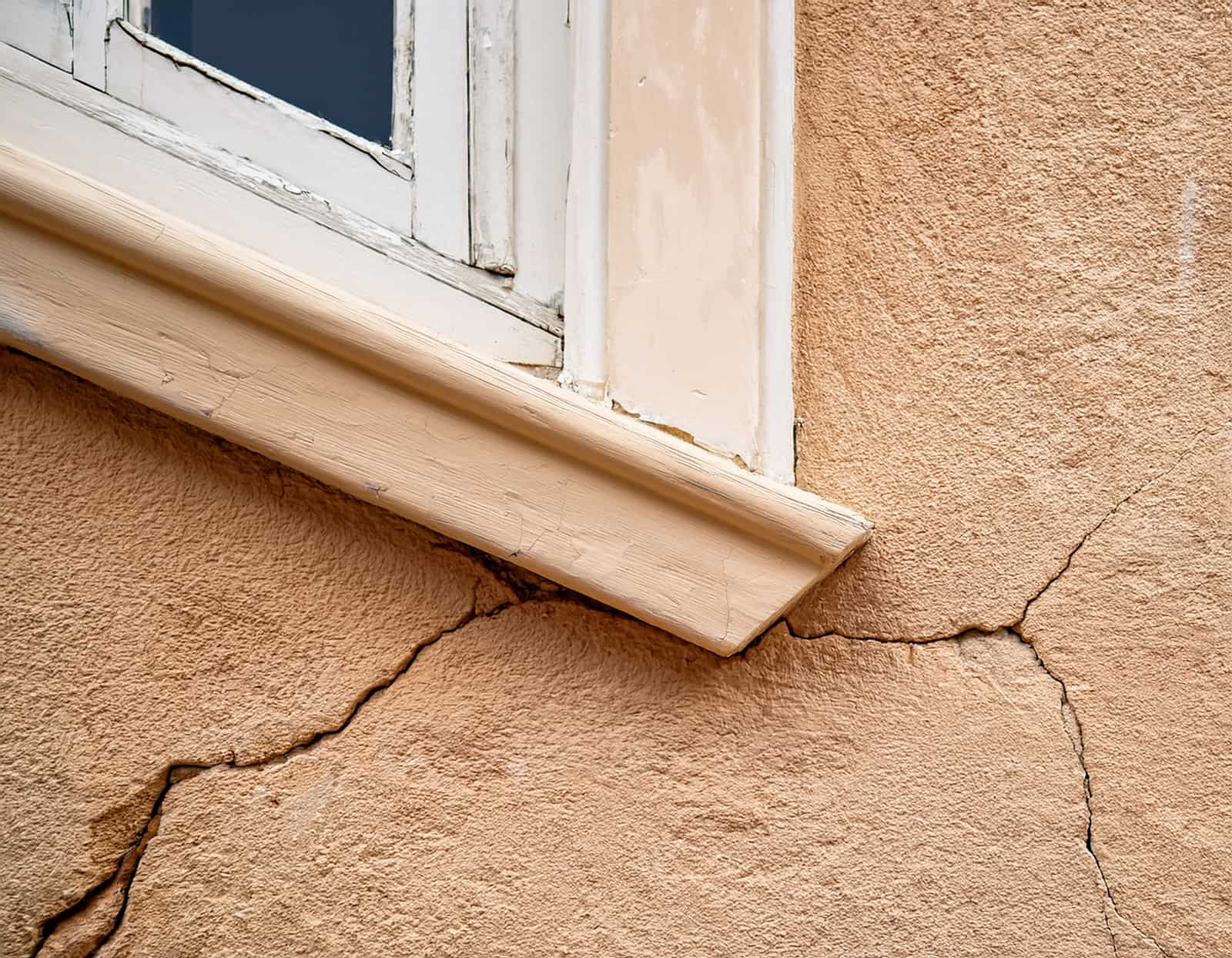
Staining at the corners of a window usually marks water on or behind the stucco there. That points to the sill, the corner joint or the flashing, and not to the stucco itself.
A soft or bubbled patch means something different. If the surface feels spongy, sounds hollow when tapped or has lifted into a blister, water has probably got behind the coating. Green or black growth near the roofline is mostly algae or mildew living on a surface that stays damp. It tells you the wall stays damp, and a gutter or a roof edge dropping water onto it is one common cause.
White, powdery or crusty deposits are salts that moving water has carried to the surface. They are a sign that water is passing through the wall, not a defect in the stucco on their own.
Step 2 of 3
See it
Each picture sits right after the section it explains.
See itIllustrates section 02: Reading the marks
Watch it happen
What the marks on stucco are telling you
Streaks run down from the window corner where water leaves the opening, a spongy blister means water got behind the coating, white deposits are salts carried by moving water, and green growth near the roofline means the roof edge is dropping water onto the wall.
1. Streaks from the corner
Dark streaks that run straight down from the corner of a window usually mean water is leaving the opening there. That points to the sill, the corner joint or the flashing, and not to the stucco itself.
2. A soft or bubbled patch
If the surface feels spongy, sounds hollow when tapped or has lifted into a blister, water has probably got behind the coating and the bond to the layer beneath has let go.
3. White, powdery deposits
White, powdery or crusty deposits are salts that moving water has carried to the surface. They are a sign that water is passing through the wall.
4. Growth near the roofline
Green or black growth near the roofline is mostly algae or mildew living on a surface that stays damp. It tells you a gutter or a roof edge is dropping water onto the wall.
Where the water usually gets in
A stucco wall is built to drain.
There is a drip edge over each opening so water is thrown off the face, flashing at the sill so water that gets in is directed back out, and a screed at the base so the wall can breathe and drain. When any of those is missing, buried or worn out, water has no exit and goes sideways.
At a window, the usual suspects are a sealant joint around the frame that has split or pulled away, a sill that is flat or tilted toward the wall, and a corner where the stucco has cracked from the frame outward. At a roofline, they are a gutter that overflows or has pulled away, a missing kickout where a roof meets a wall, and a roof edge that sheds onto the stucco. We do not repair roofs, so where the cause is the roof itself, we tell you and point you to a roofer rather than patch the wall below it.
A simple check you can do from the ground
Pick a dry day and walk the house with a phone camera.
Photograph every window and every corner of the roof edge, and look for streaks, discoloration or cracks that start at a frame. Tap the stucco gently with your knuckle around any mark. A solid, dull sound is what sound stucco gives. A hollow, drumlike sound next to a stain is a flag.
Do not probe the wall with a screwdriver, because it can damage the finish. A professional uses a moisture meter. If a spot feels soft, stop there and send the photos. Opening up a wall without knowing what is behind it can make a small problem worse and leave the house exposed overnight.
What the repair looks like
The order matters. First the water source is stopped.
That may mean resealing a joint, correcting a sill, fixing a downspout or sending a roof problem to a roofer. Then the damaged stucco is cut back to sound material, the layers behind are checked and dried, and the coating is rebuilt in the same sequence it was made.
A surface fix alone, such as scrubbing the stain, filling the crack and painting, does not stop water that is still getting in, so the mark can come back. That is why we ask where the water is coming from before we price the wall.
See itIllustrates section 05: What the repair looks like
Watch it happen
The order of a repair
The water source is stopped first, then the damaged stucco is cut back to sound material and the layers behind are checked and dried, and the coating is rebuilt in the same sequence it was made.
1. Stop the water first
The order matters. First the water source is stopped. That may mean resealing a joint, correcting a sill, fixing a downspout or sending a roof problem to a roofer.
2. Cut back to sound material
Then the damaged stucco is cut back to sound material, and the layers behind are checked and dried.
3. Rebuilt in the same sequence
The coating is rebuilt in the same sequence it was made. Surface fixes alone last as long as it takes the next heavy rain to find the same path.
When it can wait and when it cannot
Light surface algae on a shaded wall can wait and is usually a cleaning job.
A hairline crack at a window corner with no staining can be watched and photographed each season. A soft area, a blister, a stain that grows after rain or any sign that water is entering the room behind the wall should not wait, because wet framing or insulation behind stucco does damage you cannot see.
If you are not sure which side of that line you are on, send photos. We will tell you honestly whether it looks like a cleaning, a sealant job or a repair that needs the wall opened.
Step 3 of 3
Act on it
Quick answers, where to read next, and how we can help.
Questions people ask
Why does my stucco stain only under the windows?
Staining at window corners marks water on or behind the stucco. The stain is a map of where the water goes, so fixing the joint or sill matters more than cleaning the streak.
Is a bubble in the stucco serious?
It is usually a sign of water behind the coating. One small blister that has not grown may be a surface repair. A blister that is soft, growing or near a window or roof edge should be looked at soon.
Can I just paint over the stain?
Paint will cover the color but not the cause. If water is still entering, the stain or the blister can come back. Find the source first, repair, and then coat the whole wall.
What are the white deposits on my stucco?
They are salts carried out of the wall by moving water and left on the surface when it dries. They suggest water is passing through the wall. Brushing them off is fine, but they can return while water is still moving through the wall.
Do you fix the roof if that is the cause?
No. We repair stucco, EIFS and masonry. If the water is coming from a roof edge or a leak through the roofing, we say so and suggest a roofer, then repair the wall once the source is fixed.
Seeing this at your place?
Send us a few photos through the contact page and the chat there, and we'll tell you what we think.
Request an estimateOur stucco and EIFS repair workAll guides
Enduring On Construction, a New Jersey general contractor. NJ home improvement contractor registration 13VH13745900.
