Step 1 of 3
Understand it
The short answer, then why it happens.
The short answer
Water gets into a siding job most often at the openings and edges: around windows and doors, penetrations, corners, where trim meets siding, and at the base of the wall. A watertight wall has head flashing over each opening, wood and fiber cement trim with cut ends sealed or primed as the trim maker requires, a small gap where siding meets trim finished with sealant, and trim kept clear of the ground and roof surfaces by the maker's stated clearance. The boards in the middle of the wall rarely cause the problem.
Why the edges are the weak points
A flat run of siding is easy. Boards lap over one another and rain runs down the face.
Trouble starts wherever that pattern is interrupted, because every interruption is a joint, and every joint is a place where wind driven rain can find a path. Windows, doors, corners, vents and pipes are all interruptions.
That is why the trim is more than decoration. It frames each opening and covers the edge of the siding, and it works together with the flashing under it to shed water. When a wall leaks, the leak is most often at one of these places, which is why soft trim is the first sign most owners notice.
 AI-generated illustration
Windows and doors
At the top of every window and door there should be a head flashing, a thin piece of metal or membrane that sits over the top of the trim and kicks water outward over the siding below. Without it, rain that runs down the wall pools on the top edge of the casing and soaks in. It is a small detail and one of the most important.
At the sides, the siding stops a small distance short of the trim, and the gap is filled with sealant. At the bottom, the sill is sloped so water runs away from the wall and not into it. When any of these is missing, the corners of the opening are where rot starts, because water collects there and the wood stays wet.
Step 2 of 3
See it
Each picture sits right after the section it explains.
See itIllustrates section 02: Windows and doors
Watch it happen
Trim, corners and flashing: where a wall leaks
Why windows, doors and corners are the weak points, a head flashing that kicks water outward, the pooling when it is missing, a corner board kept clear of the ground or sitting on it, and a screwdriver check of the trim.
1. Why the edges are the weak points
Boards lap over one another and rain runs down the face. Trouble starts wherever that pattern is interrupted. Windows, doors, corners, vents and pipes are all interruptions.
2. Head flashing
At the top of every window and door there should be a head flashing, a thin piece of metal or membrane that sits over the top of the trim and kicks water outward over the siding below.
3. Without it, water soaks in
Without it, rain that runs down the wall pools on the top edge of the casing and soaks in.
4. Corners
At an outside corner, the siding on each side stops against a corner board or a formed corner post. Corner boards should stop short of the ground or any flat surface below them, so they can drain and dry.
5. On the ground, it wicks water
A corner board that sits on a walkway or in soil wicks up water, and the rot starts in the end grain.
6. Check your own trim
Press a screwdriver lightly into the bottom corners of each window and the trim near the ground. Wood should resist. If the tip sinks in, the wood is soft.
Corners
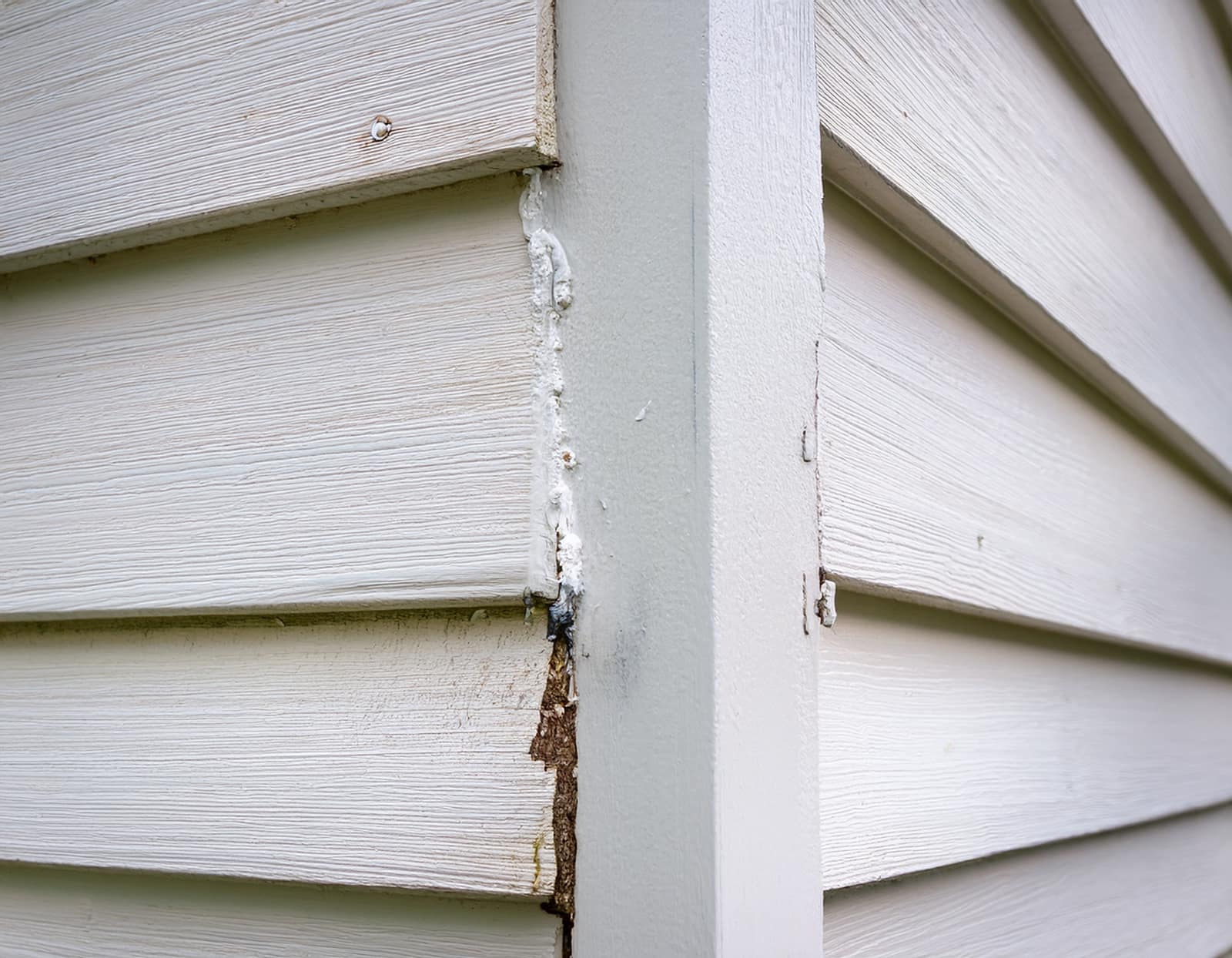
At an outside corner, the two walls meet and the siding on each side stops against a corner board or a formed corner post.
The joint between them needs to be flashed behind and sealed on the face. Inside corners are different, with a narrower post or a bead of sealant, and they collect leaves and water in the angle.
Trim should be kept clear of the ground and roof surfaces by the maker's stated clearance, so it can drain and dry. Wood trim that sits on a walkway or in soil wicks up water, and the rot starts in the end grain. If you see a stain or a soft patch at the bottom of a corner, that is the likely reason.
Trim materials and how they are sealed
Wood trim is the traditional choice, and it works when every face and every cut end is primed and sealed before it goes up.
Fiber cement trim also needs its cut ends sealed per the maker, so follow the trim maker's instructions. The faces you cannot see after installation are the ones that matter, because that is where water gets in. Composite and PVC trim resists rot better, but it still needs flashing above it, room to expand and a sealed joint. PVC trim does not need its ends sealed the way wood does.
Sealant is part of the system, and it is also the part that wears out. It shrinks, cracks and lets go of dirty surfaces. It should be checked every year and renewed when it is hard or pulling away, as part of maintenance. A joint that relies on sealant alone, with no flashing behind it, is a repair waiting to happen.
How to check your own trim
Walk around the house and press a screwdriver lightly into the bottom corners of each window, the base of each corner board and the trim near the ground.
Wood should resist. If the tip sinks in, the wood is soft, and the question is how far the damage goes. Look also for open joints, cracked sealant, peeling paint and dark staining.
A few soft spots in the trim do not mean the wall is gone, but they do mean the cause needs finding before the trim is replaced. We check the flashing, the sheathing behind it and the gutters above. Photos of each opening, with close ups of any soft areas, are enough for us to give you a first read.
When trim is replaced, what else should be looked at
Replacing rotted trim without finding out why it rotted is the most common wasted repair.
Before new boards go on, the wall under the old ones should be probed. If the sheathing is soft or dark, it needs to be cut out and replaced, and the flashing above it needs to be corrected. New trim nailed over a wet wall will rot in turn.
It is also the moment to look upward. A gutter that overflows onto a window, a downspout that dumps against a corner or a roof edge that throws water at the wall will keep soaking the same trim. Fixing the source is part of the repair, and we check it as a matter of course.
Finally, think about paint. New wood trim should be primed on every face before it is installed and painted soon after, because bare wood left through a few rains starts to take up water at once. A proper finish coat, with the caulk lines renewed, is what seals the job and gives it years of life.
Step 3 of 3
Act on it
Quick answers, where to read next, and how we can help.
Questions people ask
What is head flashing?
A piece of metal or membrane over the top of a window or door trim that turns water outward over the siding below. It stops rain from pooling on the top edge and getting behind the casing.
Is caulk alone enough to seal trim?
It helps, but it ages and cracks. Flashing and correct lapping do the main work, and the caulk is a maintenance item you check each year.
Is PVC or composite trim better than wood?
It resists rot, which is the point of it, but it still has to be flashed and installed with room to move. A bad detail leaks whatever the trim is made of.
Why does the bottom corner of my window rot first?
Water collects at the lowest point of the opening. If flashing and sill slope do not send it out, the corner stays wet and the wood softens there first.
Can trim be repaired without redoing the siding?
Often, if the sheathing behind it is sound. Some siding may need to be lifted to reach the flashing, and we check the wall behind before closing it up.
Seeing this at your place?
Send us a few photos through the contact page and the chat there, and we'll tell you what we think.
Request an estimateAll of our construction servicesAll guides
Enduring On Construction, a New Jersey general contractor. NJ home improvement contractor registration 13VH13745900.
